
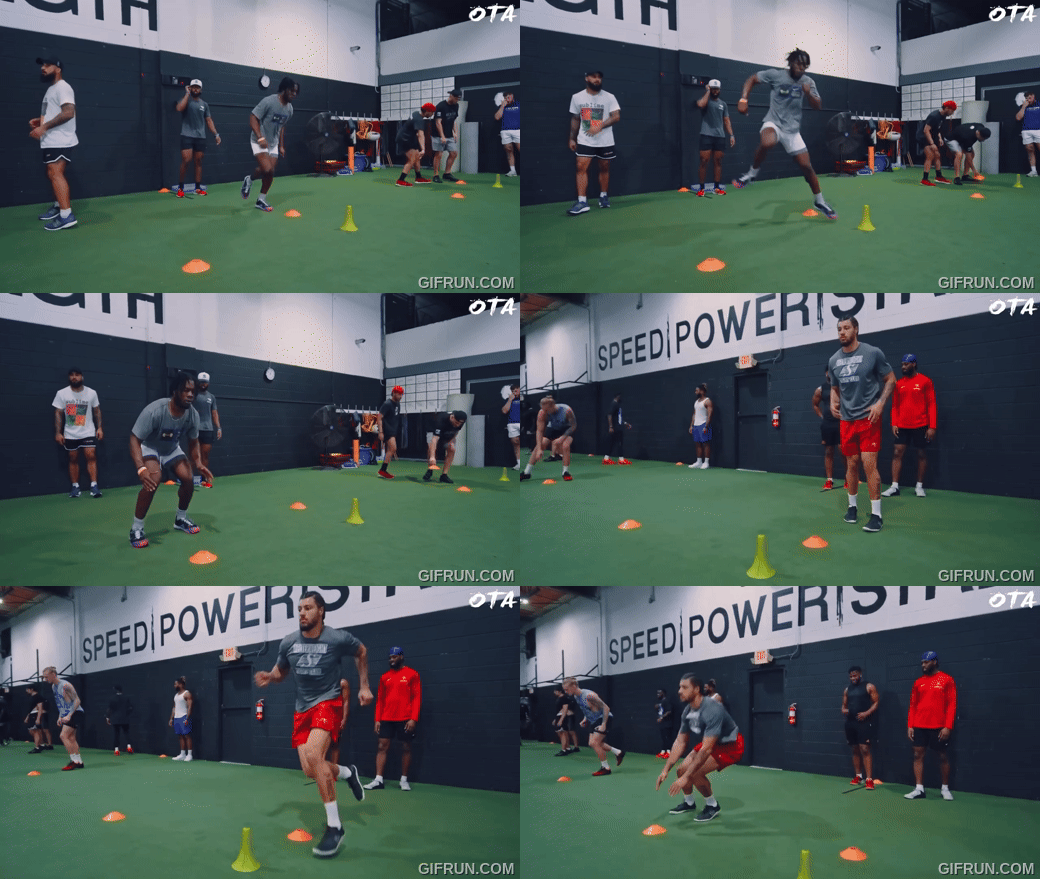
Why Most Agility Training Isn’t Actually Improving Game Speed (And How to Fix It)
Walk into almost any youth practice or sports performance facility and you’ll see the same thing.
A coach throws down an agility ladder.
A few cones get scattered across the turf.
Athletes sprint through a handful of random footwork patterns as fast as they can.
Then everyone leaves believing they just worked on “agility.”
The problem?
Most of that isn’t actually agility training.
It’s movement for the sake of movement.
No progression, structure, or purpose. And very little transfer to actual game speed.
If your goal is to become faster on the field, court, or diamond, it’s time to understand what agility really is, and how elite athletes actually train it. Make sure to go back and check out our previous article sharing the best agility drills for football!

Most Athletes Have Agility Training Completely Backwards
Somewhere along the way, sports performance became obsessed with “fast feet.”
You’ve probably heard coaches yell:
“Fast feet! Fast feet!”
Or maybe you’ve heard the saying:
“Fast feet don’t eat.”
There’s actually some truth hidden in that phrase.
Simply moving your feet as quickly as possible doesn’t automatically make you a faster athlete.
Watch an athlete sprint through an agility ladder. Their feet might be moving at lightning speed, but they’re producing almost no force into the ground. They’re taking tiny, rapid steps with very little displacement and almost zero resemblance to the movements they’ll perform during competition.
The body doesn’t care how many steps you take.
It cares how much force you can produce, and how quickly you can apply and redirect that force.
Because speed isn’t about foot speed.
Speed is force production.
And change of direction is force redirection.
If you aren’t producing force into the ground, you won’t be explosive.
Period.
That’s why an athlete can dominate every ladder drill in the gym yet still look slow during games. They’re just going nowhere really fast.
What Agility Actually Is
One of the biggest mistakes coaches make is using the terms agility and change of direction interchangeably.
They’re not the same thing.
Change of direction is exactly what it sounds like.
The athlete already knows where they’re going.
The movement is planned.
The pattern never changes.
Examples include:
- 5-10-5 Shuttle
- L Drill
- Fixed cone drills
- Planned cuts and transitions
These drills are valuable.
They teach body positioning, deceleration mechanics, shin angles, force absorption, and efficient movement patterns.
They’re foundational.
But they aren’t agility.
True Agility Is Reactive
Agility begins when decision-making enters the equation. There’s a reactive component.
Instead of knowing where to go beforehand, the athlete must react to an opponent, coach, visual cue, ball movement, whistle, or another unpredictable stimulus.
Now the brain has to process information.
The eyes gather information.
The nervous system makes a decision.
Then the body has to rapidly produce force and redirect it.
That’s exactly what happens in sports.
A linebacker doesn’t know which gap the running back will hit.
A defensive back doesn’t know which route the receiver will run.
A basketball player doesn’t know which direction the defender will attack.
A soccer player doesn’t know when an opponent will cut.
Sports are chaotic.
Agility training should be too.
Why Random Cone Drills Don’t Transfer
This is where most programs completely miss the mark.
Coaches throw together random cone drills every workout.
No progression, purpose, or measurable goal.
One day it’s zig-zags.
The next it’s figure eights.
The day after it’s another drill they saw on social media.
Athletes get tired.
Parents think they’re working hard.
But nothing is actually improving.
Good training isn’t random.
It’s progressive.
Every drill should build upon the previous one.
Movement quality improves. Force production increases. Deceleration becomes cleaner. Reacceleration gets faster. Decision-making becomes more challenging.
That’s how athletic development works.
Not through endless random cone patterns.
Train Change of Direction First
Before athletes earn reactive agility, they need movement competency.
That starts with mastering change of direction mechanics.
Athletes should learn how to:
- Lower their center of mass before cutting.
- Produce force horizontally and vertically.
- Decelerate efficiently.
- Absorb force safely.
- Create explosive reacceleration.
- Maintain proper posture and shin angles.
Think of change of direction as learning the language.
Agility is having a conversation.
You can’t expect athletes to make split-second decisions if they haven’t first mastered the movement patterns and made them natural.
Then Layer in True Agility
Once movement mechanics are solid, begin adding decision-making.
Instead of memorizing cone patterns, athletes react.
Progressions might include:
- Coach point drills.
- Colored cone or light reactions.
- Mirror drills.
- Ball drop reactions.
- Partner chase drills.
- Small-sided competitive games.
- Position-specific reactive scenarios.
Now athletes aren’t just moving.
They’re solving movement problems.
That’s exactly what happens during competition.
The best agility drills don’t look like choreography.
They look like sports.
The Bottom Line
If your agility training consists of nothing but ladders, random cone drills, and trying to move your feet faster, you’re leaving a massive amount of athletic potential on the table.
Remember:
- Speed is force production.
- Change of direction is force redirection.
- Agility is reacting while producing and redirecting force under unpredictable conditions.
Master the mechanics first.
Then progressively introduce reaction, perception, and decision-making.
That’s how game speed is built.
Not by memorizing fancy footwork.
But by developing movement that actually transfers to competition.
Ready to Train Agility the Right Way?
If you’re serious about becoming a faster, more explosive athlete, you need more than random drills pulled from social media.
You need a proven system.
That’s exactly why we created the new and upgraded Game Speed Reloaded.
Inside the program, you’ll follow a step-by-step progression that develops elite change of direction mechanics, explosive force production, reactive agility, and game-speed movement that actually carries over to competition. Every drill has a purpose. Every progression builds on the last. No fluff. No wasted reps. Just science-backed training designed to help athletes dominate when the game speeds up.
Stop confusing busy footwork with better performance.
Get Game Speed Reloaded today and start training agility like the athletes who separate themselves when it matters most.
