
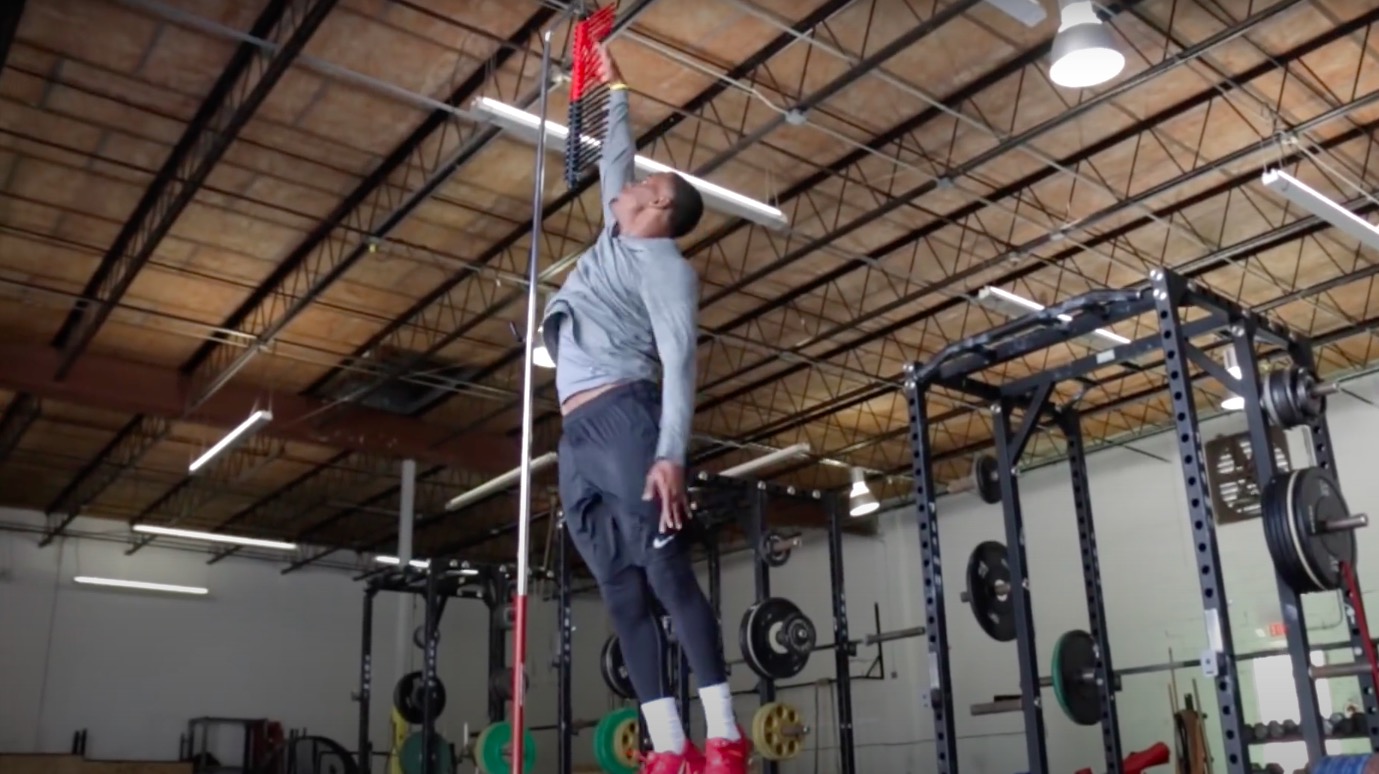
Vertical Jump Plyometric Routine: The Best Way to Prepare for Testing
When athletes prepare for a vertical jump test, most think the test starts when they step up to the measuring device.
It doesn’t.
Your vertical jump performance starts with how well you prepare your body to produce force.
If you walk into testing cold, perform a few static stretches, and immediately try to jump as high as possible, you’re leaving performance on the table. The vertical jump requires the coordinated interaction of the feet, ankles, knees, hips, and entire lower-body kinetic chain to produce as much vertical force as possible in a very short amount of time.
That means your warm-up needs to do more than raise your body temperature.
It needs to **activate the muscles, progressively load the joints and tendons, and prepare your nervous system to produce explosive force.**
The good news?
Your vertical jump preparation doesn’t need to be complicated.

You don’t need 20 different drills, a bunch of fancy equipment, or a 30-minute warm-up filled with random movements.
You need the right progressions. Make sure to go back and read our article on programming vertical jump for athletes!
Here is a simple vertical jump plyometric routine we use to progressively prepare athletes to jump at their highest level.
Why Your Warm-Up Matters for Vertical Jump Performance
A maximal vertical jump requires high levels of force production and rapid force application.
Your body needs to transition from absorbing force to producing force extremely quickly. The muscles and tendons of the lower body need to be ready to handle and redirect those forces efficiently.
That’s why we want to progressively increase the intensity of our warm-up.
We start with simple movements that prepare the foot and ankle before progressing toward more dynamic movements that require greater force production.
Think of it as taking the nervous system from 0 to 100 instead of jumping straight to 100.
The goal isn’t to fatigue yourself.
The goal is to prime your body.
You should finish this routine feeling more explosive, not tired.
1. Stationary Pogo Jumps

Start with stationary pogo jumps.
This is one of the simplest ways to begin preparing the lower leg for explosive jumping.
Stay relatively tall and focus on producing force through the foot and ankle. Keep the contacts quick and springy while trying to achieve maximum height on every repetition.
Don’t turn these into deep squat jumps.
The goal is to develop stiffness through the foot and ankle while introducing the body to repeated explosive contacts.
Think:
Quick contact. Powerful ankle. Maximum height.
This begins preparing the Achilles tendon, foot, ankle, and lower-leg musculature for the higher forces that are coming.
2. Single-Leg Stationary Pogos/Hops
Next, move into single-leg stationary pogos or hops.
Now we’re increasing the demand.
Instead of distributing force between two legs, you’re asking one leg to handle and produce the force.
This unilateral variation helps athletes develop greater force production through one side while also challenging balance, coordination, and stiffness.
Again, focus on quality.
Don’t rush through these just to complete repetitions.
Think about being aggressive with each contact and producing as much force as possible while maintaining control.
3. Low Squat Jumps
Now we begin involving more of the lower body.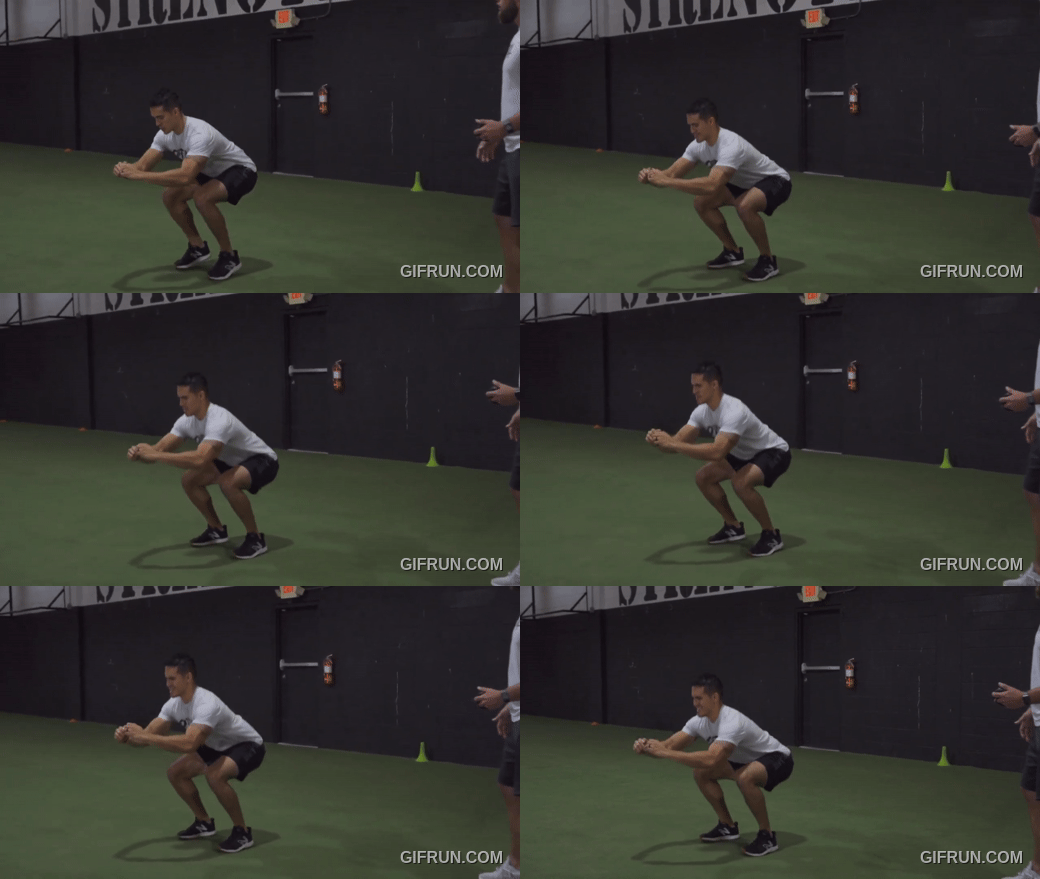
The low squat jump introduces a greater range of motion while placing the muscles and tendons in a more lengthened position before producing force.
This is important because your vertical jump isn’t just an ankle movement.
The calves, quads, hamstrings, glutes, and surrounding connective tissues all contribute to producing vertical force.
The low squat jump starts preparing those tissues to handle force from a deeper position and then rapidly redirect that force into the ground.
Keep the repetitions explosive and controlled.
4. Squat Jumps
Next, progress into full squat jumps.
Now the objective becomes much more about **force production through the entire lower-body chain.**
Start in your squat position and aggressively drive through the ground.
Think about extending the ankles, knees, and hips together and projecting your body vertically.
This is where we’re beginning to bridge the gap between general preparation and maximal jumping.
You should feel increasingly explosive with every progression.
5. Power Skips for Height
Now we’re moving into a more dynamic plyometric.
Power skips for height require you to produce vertical force rapidly through a single leg while coordinating the entire body.
Drive the knee up aggressively and focus on getting as much height as possible with each skip.
This is a great bridge between your lower-intensity plyometrics and the maximal effort vertical jump.
You’re asking the body to produce more force, more quickly, while maintaining rhythm and coordination.
The nervous system is now getting much closer to the demands of the actual test.
6. Power Skips for Distance
Finish with power skips for distance.
This might seem strange when we’re preparing for a vertical jump, but horizontal force production is still an important part of athletic power.
Power skips for distance challenge the athlete to produce force aggressively and increase the rate of force production.
You’re covering more ground with each contact and creating a more dynamic movement pattern.
This final progression helps take your body from controlled plyometric contacts to more aggressive, explosive force production.
By this point, your feet and ankles are prepared.
Your tendons have been progressively loaded, muscles are activated, and joints have been exposed to increasing levels of force.
Final Thoughts
The best vertical jump warm-up isn’t necessarily the longest or most complicated.
It’s the one that prepares you for what you’re about to do.
When you’re testing your vertical jump, you want to be able to express as much force as possible. That means your warm-up should progressively prepare your body to handle and produce that force.
- Start with the foot and ankle.
- Progress to unilateral force production.
- Increase the range of motion.
- Increase total lower-body force production.
- Then transition into dynamic, explosive movements.
That’s what this progression accomplishes.
Use these six movements before your next vertical jump test and treat them as a primer, not a workout.
Keep the volume low, the intent high, and every repetition explosive.
You shouldn’t finish your warm-up exhausted.
You should finish it thinking:
“I’m ready to jump.”
And remember, warming up properly is only one piece of improving your vertical jump. If you want to actually build a higher vertical, you need a structured system that develops strength, power, reactive ability, and explosive force production over time.
That’s exactly what we built the Elite Vertical Academy to do.
If you’re serious about jumping higher, becoming more explosive, and maximizing your athletic performance, stop guessing and start following a proven progression.
