
The Best Step Ups Exercise Variations for Explosive Athletes
The step ups exercise is one of the most underutilized but highest-return movements in athletic performance training. Most athletes treat it like a basic accessory lift, but in reality, step ups are a foundational unilateral strength builder that directly transfers to sprinting, jumping, cutting, and overall field or court performance.
If you’re training athletes and you’re not programming step ups exercise variations with intention, you’re missing a major piece of long-term athletic development.
The reason step ups are so powerful is simple: they force single-leg control under load while teaching force production through a functional range of motion. Unlike machines or even bilateral lifts, step ups expose and correct side-to-side imbalances while building real-world strength patterns that athletes actually use in sport.
But not all step ups are created equal. The real value comes from understanding how different variations create different adaptations. We can break the step ups exercise into three key categories: correctives, strength, and power. Read our previous article on the best exercises for lower body strength here!
1. Corrective Step Ups Exercise Variations
Corrective work is where most athletes need to start, especially if they lack control, stability, or have poor single-leg mechanics.
Iso Step Downs
Iso step downs are one of the most effective ways to build unilateral stability. The athlete stands on a box and slowly lowers the non-working leg toward the ground while maintaining full control on the working leg.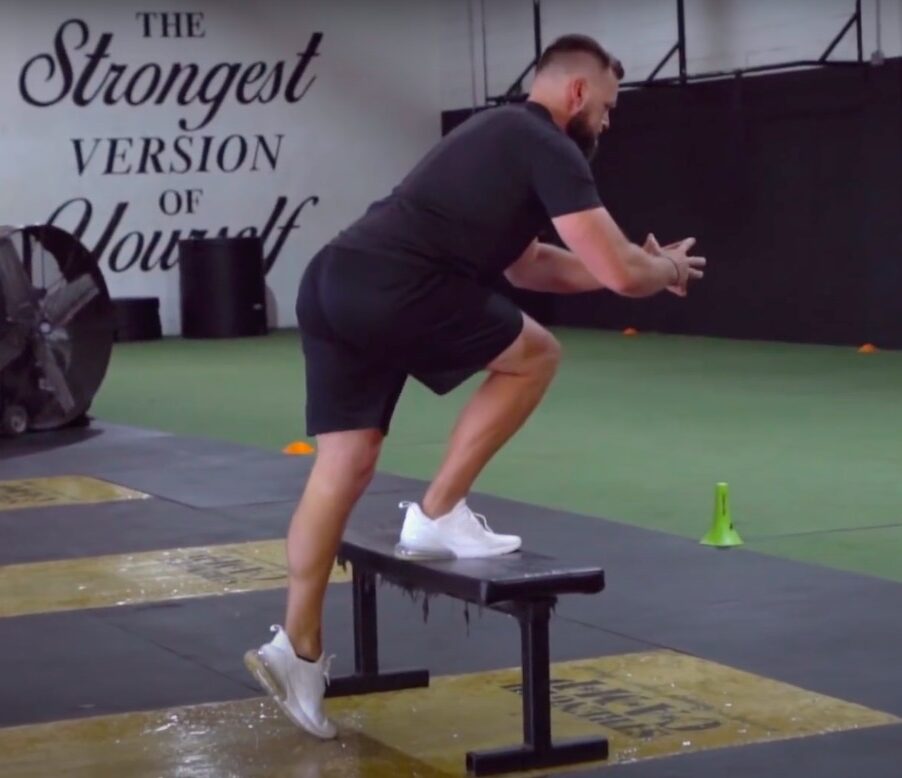
The goal is not speed. The goal is control, alignment, and stability under tension. This variation teaches the athlete how to own single-leg positions, especially in the hips, knees, and ankles.
Key coaching points:
- Stay tall through the torso
- Control the descent slowly
- Keep knee tracking over toes
- Avoid collapsing into the hip
This builds foundational stability that carries over to sprint mechanics and deceleration ability.
Decel Step Downs
Deceleration is one of the most overlooked athletic qualities, yet it shows up in every sport. Decel step downs train the eccentric strength required to absorb force safely and efficiently.
In this variation, the athlete steps down off a box and emphasizes a controlled eccentric lowering phase, resisting gravity instead of dropping into it.
Key benefits include:
- Improved eccentric strength
- Better joint control under load
- Reduced injury risk in cutting and landing
If an athlete can’t decelerate well, they can’t accelerate efficiently. This drill builds the brake system before upgrading the engine.
2. Strength Step Ups Exercise Variations
Once athletes have stability and control, we move into true strength development. This is where the step ups exercise becomes a heavy unilateral builder.
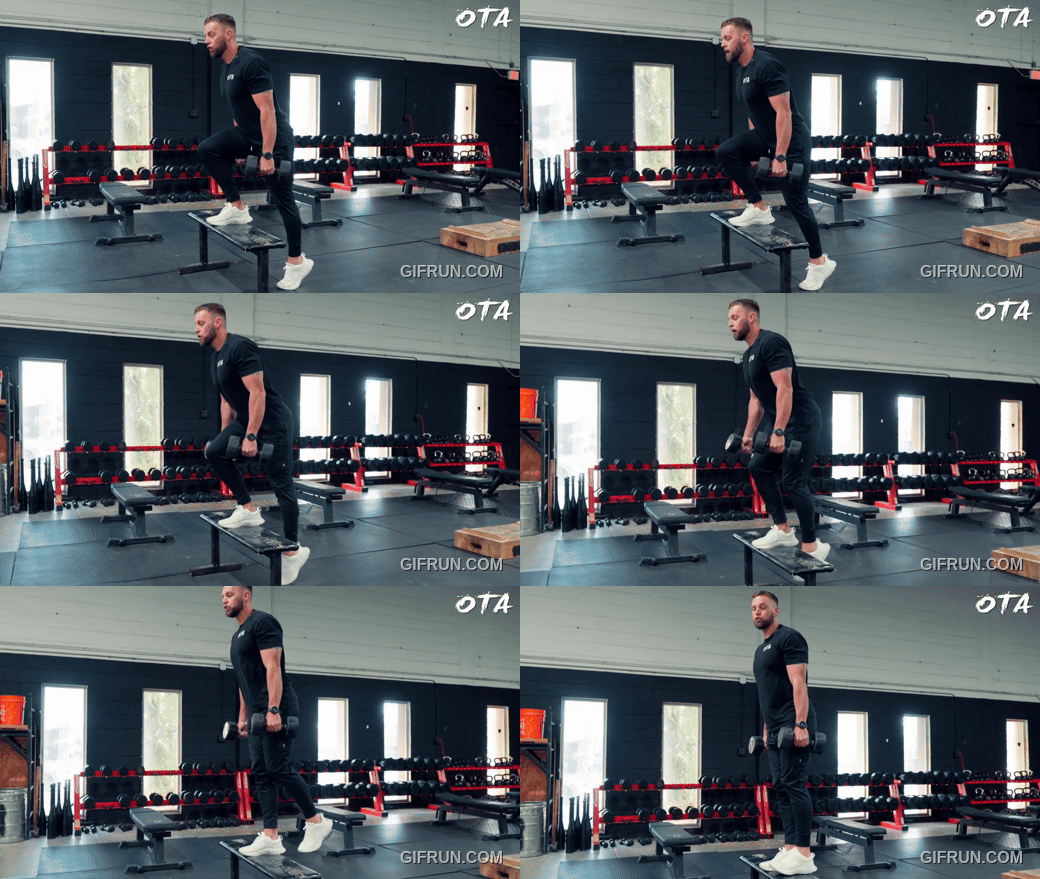
Weighted Step Ups

The classic weighted step up is the foundation of unilateral strength. The key is loading it heavy enough to challenge force production without losing control.
The biggest coaching mistake here is allowing the back leg to assist. The non-working leg should NOT be pushing off. It’s simply support. The entire drive should come from the lead leg.
Key cues:
- Drive through the full foot (not toes)
- Control the eccentric on the way down
- Do not bounce off the trailing leg
- Maintain upright torso or slight forward lean depending on sport
This variation builds:
- Quad strength
- Glute development
- Single-leg force production
- Structural balance between limbs
Crossover Step Ups
The crossover step up adds a rotational and frontal plane demand, which better mimics sport movement patterns like cutting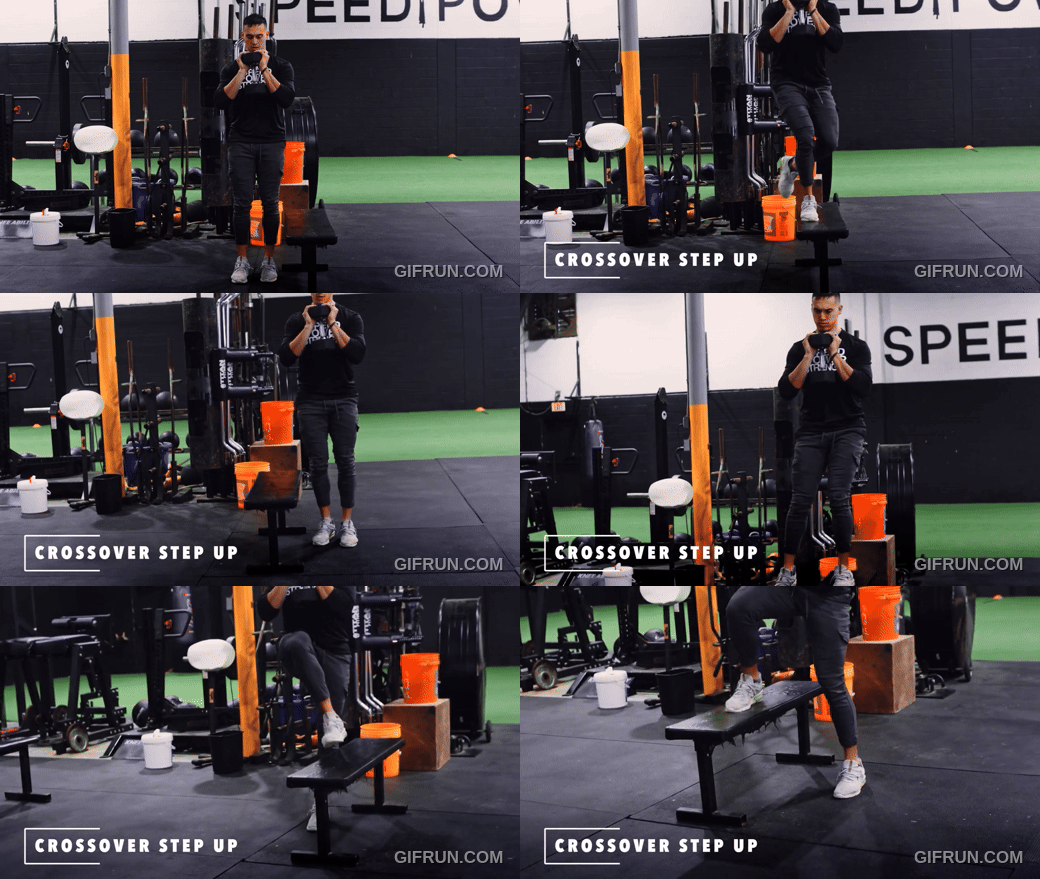 and lateral transitions.
Instead of stepping straight up, the athlete crosses the front leg over and steps onto the box at an angle.
This variation enhances:
- Hip stability in rotational positions
- Adductor and glute med engagement
- Sport-specific unilateral strength
It also exposes weak links in lateral control that straight-line lifts often miss.
3. Power Step Ups Exercise Variations
Once strength is built, the next step is converting it into explosive output. This is where the step ups exercise transitions from strength builder to power developer.
Sprinter Step Ups
Sprinter step ups are designed to build plyometric volume and vertical force expression. The athlete drives explosively from the ground into a sprint-like knee drive at the top of the step.
This variation teaches:
- Rapid force production
- Triple extension mechanics
- Sprint transfer from weight room to field
Think of it as a bridge between strength training and sprint mechanics.
Key focus:
- Explosive drive off the box
- Aggressive knee lift
- Minimal ground contact time
- Controlled landing back to reset
Step Up Launches
Step up launches are the highest intensity variation in this progression. The athlete drives explosively off the step and launches into a ballistic movement pattern as high as they can off the bench or box and lands two feet on the ground.
This is pure power expression.
Benefits include:
- Max force production
- Improved rate of force development (RFD)
- Better transfer to jumping and sprinting
- High neural demand training stimulus
The goal is not volume. The goal is intent. Every rep should look like maximum output.
Final Thoughts
The step ups exercise is not just an accessory movement—it is a complete unilateral training system when programmed correctly. From corrective stability work to heavy strength development and explosive power output, step ups can build a complete athlete when used intentionally.
If you want stronger, more balanced, and more explosive athletes, you don’t need more complicated exercises. You need better execution of the basics.
And the step ups exercise, when progressed properly, is one of the best basics in athletic performance training.
